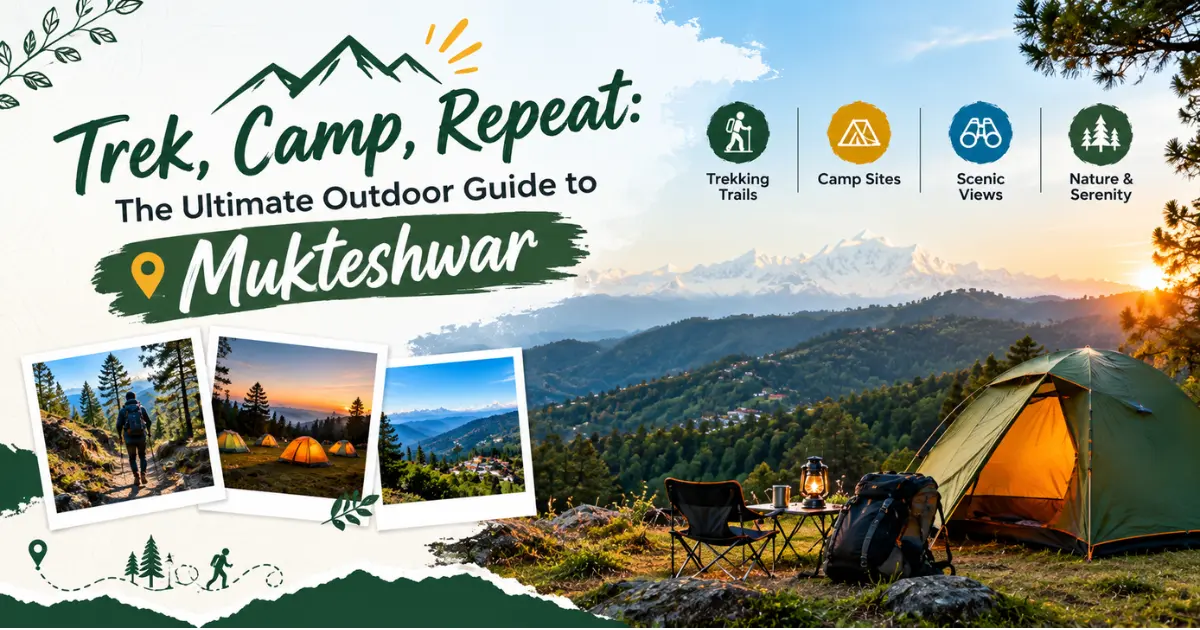
Most travelers know Mukteshwar for its mountain views and peaceful atmosphere. But the views are not the destination; they're the byproduct of a landscape built for outdoor movement. Beyond the viewpoints and cafés lies an entirely different site. It includes forest trails that change character as you climb, and cliff edges with nothing between you and the Himalayan range. You have campsites where the sky at night is genuinely disorienting, and a serene pace of outdoor life that you rarely find at commercial and more crowded hill stations.
Whether you're planning your first Himalayan trek, a weekend camping trip, or simply looking for ways to spend more meaningful time outside, Mukteshwar offers you all. In this guide, you'll find the best treks, camps, viewpoints, nature walks, outdoor activities, seasonal recommendations, safety guidance, and the hidden details. It helps you plan a good trip and one you plan to repeat. So keep reading to know more!
Mukteshwar is not optimized for tourists, and that's its most important quality. No mall road, no cable car, no managed viewpoints with ticketing queues. The infrastructure here serves the people who live in it, not the people passing through. That distinction changes how outdoor exploration feels at a fundamental level.
Commercial hill stations like Nainital and Mussoorie compress the visitor experience into a few named attractions surrounded by crowds. Mukteshwar spreads the experience across the whole landscape. A morning walk through the orchard paths above Sitla village, a quiet hour on the ridge above IVRI, a sunset watched from an unmarked hillside, none of these appear on a list of "top attractions," which is exactly why they deliver what the list-destinations can't.
The slower pace isn't a limitation here. It's the mechanism through which the place actually works. Travelers who fight it leave with a handful of viewpoint photographs. Travelers who accept it leave with a version of the mountains that stays with them.
At 2,286 meters in the Kumaon hills of Uttarakhand, Mukteshwar sits high enough for genuine mountain conditions while remaining accessible to a wide range of travelers. The terrain shifts quickly, with Chir pine forest on the southern ridgelines, dense Banj oak on the cooler north-facing slopes, open meadows at the top, rocky cliffs at Chauli Ki Jali, and stream-fed forest corridors running down to the valley. That variety within a small area means a day of outdoor movement covers genuinely different ground rather than repeating itself.
The Himalayan range is visible from the upper ridgelines on clear days with a directness that more enclosed Kumaon towns don't offer. Nanda Devi at 7,816 meters, Trishul at 7,120 meters, and the Panchachuli massif are all identifiable on a good autumn morning. That proximity to the high Himalaya, without the altitude acclimatization requirements that actual high-altitude trekking demands, is one of the defining geographic advantages of the destination.
Nainital is 51 kilometers downhill and roughly 90 minutes by road. That proximity gives Mukteshwar an easy connectivity that genuinely remote destinations lack, easy enough to reach on a long weekend, but far enough to feel like a real departure. But the altitude, the winding approach road, and the absence of large-scale tourist infrastructure create a natural filter. The travelers who come here came specifically for the mountains, which changes the atmosphere on the trails considerably.
From Delhi, Kathgodam is the rail head, about 5.5 hours by train, followed by 70 kilometers of hill driving. That combination is enough distance to produce the mental shift that makes a mountain trip feel worth the effort, without requiring the multi-day journey that the higher Himalaya demands.
The trails at Mukteshwar don't follow the standard Indian trekking format of base camp, checkpoint, and summit. They move laterally through terrain that keeps changing rather than grinding toward a single high point. That structure works for a much wider range of travelers, and it means the trail experience is about the landscape you move through, not the elevation you gain.
Crowds are low by any meaningful comparison. On peak autumn weekends, the popular routes see visitors, but not the queue conditions that comparable terrain around Nainital produces. Start before 7 am on any named trail, and the solitude is close to complete, which is the condition that makes trail walking in the mountains feel like it's supposed to.
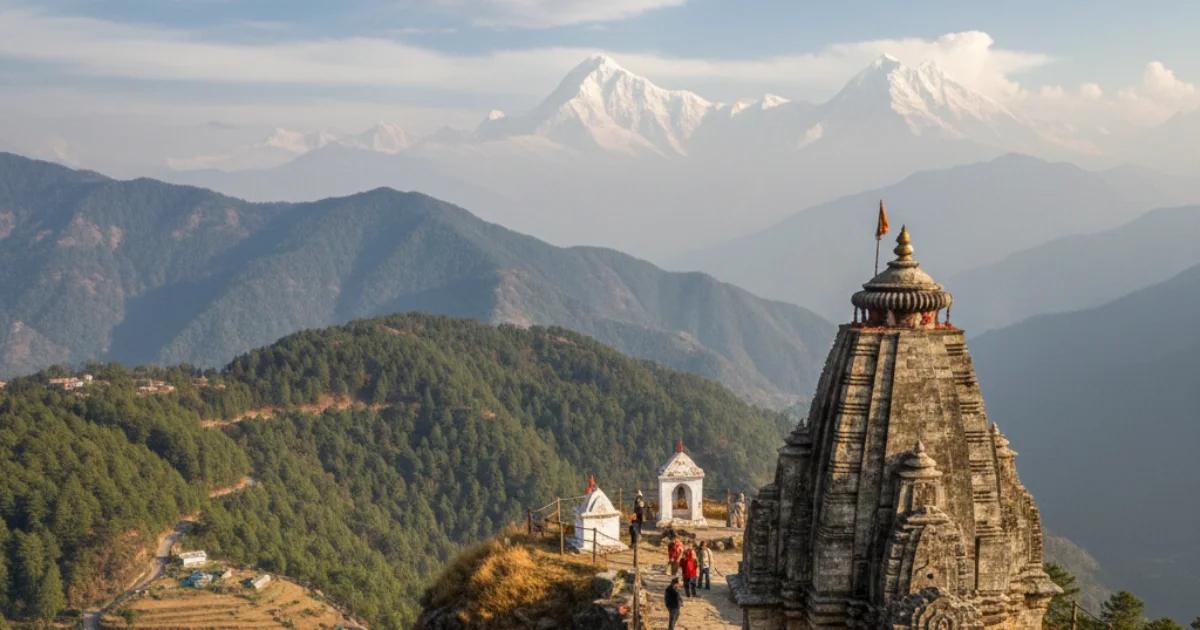
The trail to the Mukteshwar Dham Temple leads to the highest accessible point in the town, and it earns more than the modest effort it requires. The path winds uphill through forest that opens progressively as you climb, with valley views appearing in sections before the full panorama arrives at the top. The temple itself is an ancient Shiva shrine whose position in the landscape makes clear why it was built exactly here rather than anywhere else.
Pair this walk with Chauli Ki Jali, both are nearby and the combination covers the essential Mukteshwar landscape in a single morning. For sunrise, arrive 30 minutes before first light. The Himalayan range in the first twenty minutes of dawn from this elevation is the most-photographed moment in the destination, and the image is accurate to the experience.
Best for: Families, first-time visitors, spiritual interest, sunrise photography.
Chauli Ki Jali is the trail most associated with Mukteshwar, and what makes it worth its reputation isn't only the destination. The approach matters, the forest transition as you gain elevation, the specific point where the canopy breaks and the ridgeline opens, the shift from enclosed pine cover to exposed sky. Most visitors focus on the cliff viewpoint at the end. The walk there is equally worth attention.
The cliff edge itself delivers a wide Himalayan panorama with the Kumaon valleys dropping on both sides. Come early, rock climbing and rappelling groups work these faces through mid-morning, and the activity level rises noticeably after 9am. Early arrivals get the place in quiet, which is its best version. The edges are unfenced. Manage this honestly with children and in wet conditions.
Best for: Photography, adventure activity, sunrise views, repeat visitors.
This is the trail that consistently surprises visitors who come in expecting something simple. The path follows a stream through a narrow forest corridor, wooden bridges, constant sound of moving water, dappled light through dense canopy. It doesn't ask much physically, which frees attention for everything else. The birding along this route is the best in the Mukteshwar area; binoculars earn their bag weight here specifically.
The waterfall at the end runs properly from July through October when the stream is at volume. Outside that window it's still attractive, just smaller. The trail surface gets slippery after rain, grip rubber on your shoes matters more than ankle height here.
Best for: First-time trekkers, families, birders, monsoon visitors, anyone with limited time.
The paths connecting Mukteshwar to Sitla, Ramgarh, and the smaller settlements south of the main town are where the destination reveals itself most honestly. Apple and plum orchards alternate with terraced fields. Sections of older forest appear between farmland. The villages move at a pace that the trails reflect.
These routes resist being rushed, which is exactly their value. For slow travelers, couples, and photographers working in natural light, the village trail network delivers more per hour than any named viewpoint. Take a rough direction, not a fixed route. Tell your accommodation where you're heading. Be back before dark.
Bhalu Gaad Waterfall, easy terrain, clear path, forest cover, rewarding end point without technical demands.
Mukteshwar Temple, short, accessible, heritage interest, panoramic reward at the top.
Mukteshwar Temple summit, highest accessible point, eastern orientation, Himalayan arc visible from Nanda Devi to Panchachuli on clear days.
Camping in Mukteshwar is not about roughing it. The established operators have been refining their setups over years, tent placement for morning views, meal timing around the trail schedule, fire management that produces a fire that actually provides warmth rather than just atmosphere. What no operator can provide is the sky. At 2,286 meters, away from town light, the Milky Way is a visible structure. Not a faint suggestion, a structure with depth and detail. That alone justifies a camping night over a hotel stay for the right traveler.
The other argument for camping is timing. The best version of Mukteshwar, the hour before the trails fill, the light on the peaks before anyone else is awake, is only accessible if you're already in position before it happens. A hillside campsite delivers this daily. A hotel delivers it to whoever happens to set an alarm.
Luxury Glamping: Fully managed camps with proper bedding, heating arrangements, and full meal service. The outdoor experience is genuine, location, sky, morning views, but the comfort floor approaches a good guesthouse. Best for couples, first-time campers, and travelers who want the experience without operational friction.
Riverside Camps: Located near the Bhalu Gaad stream system. Moving water at night, morning bird activity, more enclosed than the ridge camps. Suits travelers who find open-sky camping less comfortable than forest surroundings.
Forest Camps: Set in private orchards or wooded land. Middle ground between glamping and adventure camping, closer to nature, meals and fire handled well. Best option for small groups wanting genuine outdoor experience with functional logistics.
Adventure Camps: Basic camping paired with activity packages, rock climbing, rappelling, valley crossing. Located near the Chauli Ki Jali ridge. Best for groups with specific activity goals.
Late afternoon arrival: Check in, tent orientation, first view of the campsite. This is when expectations recalibrate, usually upward.
Sunset: Temperature drops fast. Position for the color sequence on the Himalayan range in the 45 minutes before and after sunset. Worth being outside for it rather than inside the tent.
Campfire and dinner: The fire here provides actual warmth, not just ambience. Food at the better camps is simple and good, local dal, sabzi, roti. Eat outside if the cold allows it.
Stargazing: Clear nights, common outside the monsoon, deliver a sky that takes a few minutes to adjust to. A phone torch destroys dark adaptation for 20 minutes. Use a red light if the stars are the reason you're there.
Sunrise: The argument for camping over every other accommodation format in Mukteshwar. Being positioned on a hillside when the first light hits the Himalayan peaks, before other travelers are awake, is the version of this place most day visitors never access.
This is the most famous viewpoint in Mukteshwa, and for good reason. The cliffs are dramatic, the views are wide open, and the landscape feels much bigger than you expect. From here, the Kumaon valleys drop away on both sides, while the Himalayas stretch across the horizon. The best time to visit is early in the morning. Before 9 a.m., the area is usually quieter, and the views feel more peaceful. So, arrive early, stay awhile, and let the view do the talking.
This is the highest easily accessible point in Mukteshwar, and the views reflect that. On a clear morning, the Himalayan range opens up in a wide sweep across the horizon. Peaks like Nanda Devi, Trishul, and Panchachuli stand out clearly. Most people arrive at sunrise. The better approach is to get there 25 to 30 minutes earlier. It's one of those rare places where waking up early genuinely pays off.
If you're looking for a quieter alternative to the more famous viewpoints, this ridge walk is well worth the extra effort. Unlike dramatic cliff-edge viewpoints that focus all the attention on a single spot, the experience here unfolds gradually. The trail follows the ridge above Sitla village, with mountain views stretching alongside you for much of the walk. The scenery changes as you go. New angles appear around bends and valleys open up and close again. The mountains stay in sight, but the view keeps shifting from one angle to another. It's also a great choice for anyone who enjoys walking simply for the sake of walking.
The best sunset spots in Mukteshwar usually aren't the ones you'll find on maps or travel websites. They're often quiet stretches of orchard roads above the main town, where the landscape and light come together at just the right angle. Instead of searching online it would be better to ask the locals who know the place best. Long-running homestays, guesthouses, and local hosts usually know exactly where to go for the season`s best sunset views. You can just interact with the locals and in a quick conversation they can direct you to the best locations in the region.
The combination of forest types at this elevation, oak, pine, rhododendron, mixed secondary growth, creates habitat variety that produces a species count significantly higher than single-forest environments. The area connects to the broader Kumaon hills bird zone, which means passage migrants supplement the resident population in October–November and March–April. Casual observers find it consistently rewarding. Serious birders treat it as a productive half-day addition to a Kumaon circuit rather than a standalone destination, which is the honest framing.
October through April covers the winter residents plus the autumn and spring passage windows. The Bhalu Gaad trail and the oak forest sections near IVRI are the two most productive areas. The operational window is 6am to 9am, forest canopy activity drops sharply as temperature rises through mid-morning.
The Chir pine forest covering much of the upper ridgeline creates walking conditions that are specific: open understory, good sight lines, needle-cushioned trail surface, long shadows in late afternoon light. These sections are drier and more exposed than the oak forest, better for sunny day walking, less protected against wind and rain.
The Banj oak forest on the cooler north-facing slopes is a different environment entirely, denser, more layered, richer in bird and plant life. Rhododendron arboreum grows throughout and produces the red floral display in March and April that covers Kumaon hillsides annually. It is best in spring for the visual drama, and in autumn for the cooler, more enclosed walking atmosphere.
March through May brings Burans rhododendron, Himalayan cherry, and several orchid species to the forest sections. The meadow areas above the main town develop wildflower coverage in late April that photographers specifically schedule around. By June the green is uniform but species diversity is low before the monsoon triggers a second flush.
Shinrin-yoku, the Japanese concept of slow, attentive time in forest environments, has entered mainstream travel language, and Mukteshwar's forest network is one of the better settings for it in Uttarakhand. The combination of pine scent, cool temperature, and the acoustic quality of a forest without road noise is specific to this elevation and forest type. No structured program is required. The walks are enough, at the pace they naturally produce.
Every season here delivers a genuinely different version of the destination. The question isn't which is objectively best, it's which version matches what you're after.
Spring (March–April)
Dry trails, rhododendrons in bloom, sparse crowds. The most underrated window in the annual calendar. Mornings remain cold; afternoons warm quickly. Best for wildflower photography, birding, and the transition from winter quiet to summer activity. Book accommodation early, the value of this window is becoming more widely known.
Summer (May–June)
Peak visitor season, and justifiably so. Cool days, pleasant evenings, ideal conditions for long walks and camping. Book accommodation two to three weeks ahead for weekends. Start outdoor activities before 9am to beat heat buildup and the arrival of later-rising visitors on the popular trails.
Monsoon (July–September)
The season most guides treat cautiously and undervalue in the process. The forest deepens, waterfalls run at full volume, cloud formations create photographic conditions the other seasons don't offer. Some trails require extra care underfoot. Best for nature-focused travelers with flexible schedules, this is not the window for fixed itineraries.
Autumn (October–November)
The trekking and camping peak. Sharpest Himalayan visibility of the year, comfortable temperatures, best overall outdoor conditions. The first three weeks of October specifically, book early. This window fills faster than most travelers expect.
Winter (December–February)
Quiet, cold, and specific. Snowfall is possible but not guaranteed. Trails are largely empty, Himalayan clarity on clear days is extraordinary, and the campfire becomes genuinely necessary rather than decorative. For repeat visitors, couples, and photographers, this is the most honest version of Mukteshwar available.
Mukteshwar Temple summit, Best overall for Himalayan visibility and light quality. Arrive 25 to 30 minutes before sunrise. October–November sunrise falls between 6:15 and 6:45am.
Chauli Ki Jali ridge, Better for dramatic cliff composition. Early enough and the place is completely quiet. Light on the peaks works well from this position from October through March.
The orchard and meadow areas above the main town catch western light through the golden hour. The Sitla ridge walk delivers sustained western views with more walking distance. Sunset at this elevation moves fast, the color window is 15 to 20 minutes. Be positioned before you think you need to be.
Sunrise viewpoints: 25–30 minutes before local sunrise. Check cloud cover the evening before, no point in a 5am alarm for a closed sky. Sunset viewpoints: 30 minutes before, stay 20 minutes after. The light continues working after the sun drops below the horizon.
Expecting a Busy Tourist Town
Travelers arriving from Nainital sometimes experience Mukteshwar as anti-climactically quiet. They're measuring against the wrong standard. The quiet is not a deficit, it's the specific condition that makes the outdoor experience here work. If you arrive expecting Nainital's small road density and find instead a small market and empty trails, the correct response is recalibration, not disappointment.
Underestimating Mountain Weather
Cool mountain air suppresses the usual heat signals that remind you to drink water and apply sunscreen. Dehydration develops invisibly. UV intensity at 2,286 meters is higher than it feels. The temperature drop after sunset in any season is sharper and faster than most travelers from the plains have experienced before. One extra warm layer, consistent water intake, and sunscreen solve all three problems. Skipping any of them is the single most common reason a good day turns uncomfortable.
Skipping Sunrise
This is the most expensive mistake in Mukteshwar, in the sense of what it costs in terms of what you miss. The gap between first light and 8am is when the Himalayan visibility is sharpest, the trails are empty, and the light on the peaks is doing its best work. Every hour of sleep past 6am has a direct cost here that isn't recoverable later in the day. Set the alarm.
Not Staying Long Enough
Mukteshwar takes half a day to decompress into, to let the altitude register, the pace shift, the outdoor schedule replace the city one. A one-night stay covers the surface. Two nights finds the rhythm. Three nights delivers the version people come back for. Travelers who treat it as a quick overnight in a longer itinerary consistently leave feeling they needed one more day.
Mountain weather changes faster than any app predicts. A clear morning can become a cold, cloudy afternoon within two hours, particularly in the monsoon shoulder periods. Check the forecast the evening before and carry rain and wind protection regardless of the morning sky. The temperature drop after sunset at this elevation is consistent across every season, it is not a winter-only consideration.
The cliff edges at Chauli Ki Jali are unfenced. Monsoon-wetted rocks are unreliable on the approach sections. Start long treks early enough to return before dark, the 5pm sunset in winter reduces the operational window significantly compared to summer. Tell your accommodation your planned route before leaving on any trail that takes you more than 30 minutes from the road network.
Leave the campsite exactly as you found it. Campfire management in dry conditions, spring and autumn, requires attention; ensure fires are fully extinguished before sleeping. The natural quality of these camping locations is precisely what makes them worth booking, and it degrades faster than most visitors realize when treated as a shared resource without shared responsibility.
Leopard presence in the forests around Mukteshwar is confirmed but sightings are uncommon. Standard precautions apply: don't walk alone on remote trails after dark, keep noise reasonable in forest sections, and don't leave food accessible outside tents at night. These are sensible habits for any forest environment, not emergency protocols specific to Mukteshwar.
Mobile connectivity is adequate in the town center and on main trail approaches, but drops on remote sections. The nearest hospital with meaningful capacity is in Haldwani. Carry personal medications and a basic first-aid kit on any trail longer than two hours. A charged phone and a power bank are the most consistently useful safety preparations for this destination.
Some destinations work once. Mukteshwar works differently every time, because the seasons change it significantly enough that repeat visits cover genuinely new ground, and because the outdoor life here is varied enough that no two trips follow the same sequence.
The people who return to Mukteshwar year after year are rarely the ones who tried to see everything in a single trip. They're the ones who settled into its rhythm. Early mornings with the mountains slowly waking up. Long walks without a destination in mind. Hours spent outdoors instead of rushing between attractions. Evenings that end around a campfire, a conversation, or a quiet view rather than another screen. These are all what makes people keep coming to this place. It is an experience designed for visitors.
Mukteshwar doesn't ask for much. It asks that you show up early, move slowly, and pay attention. The mountains handle everything else. Pack accordingly. Start before you think you need to. Let the place set the schedule. It already knows what it's doing.