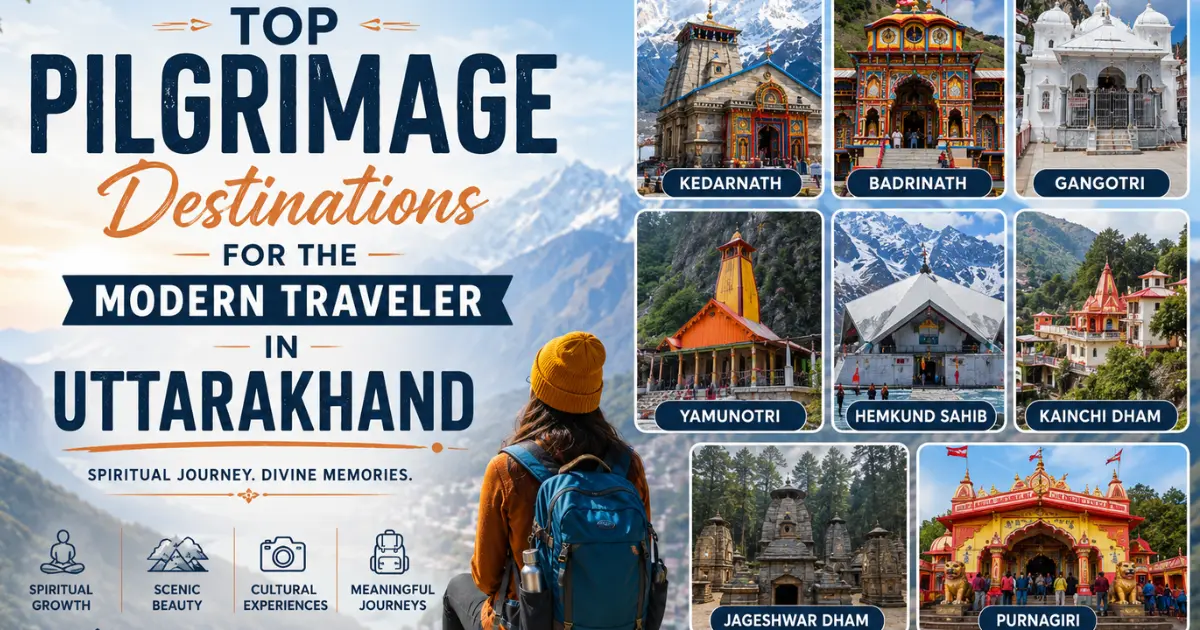
Uttarakhand doesn't have one single pilgrimage. It has a whole range of them. And where you fit on that range matters more than any top-10 list of temples ever will. On one end, there's the Char Dham circuit. Four shrines, deep in the Garhwal Himalayas. You get there by trekking, by pony, or by helicopter. The climb to Kedarnath alone is 16 kilometres and it tests your body just as much as your faith.
On the other end, there's Kainchi Dham. A small Hanuman ashram in the Kumaon hills. Steve Jobs came here in his twenties, looking for clarity. Today, you might stand next to a startup founder taking a breather between funding rounds, right beside someone who's chanted the Hanuman Chalisa their whole life. Both are real pilgrimages. Both are Uttarakhand.
But most guides treat them like the same trip. That's the problem. That's why people show up over-prepared for an easy day out, or badly under-prepared for a Himalayan trek. This guide won't do that. This guide provides detailed information about different pilgrimage destinations by what actually matters. You will learn how hard the trip is, how crowded it gets, and how it will actually feel once you're standing there.
Before we get into individual places, let's zoom out. Here's how the major sites stack up, on the things that actually decide whether your trip feels meaningful, or just miserable.
|
Destination |
Physical Demand |
Best For |
Ideal Season |
Days Needed |
Crowd Level |
|
Kedarnath |
Very High (16 km trek or helicopter) |
Devout pilgrims, serious trekkers |
May–June, Sept–Oct |
2–3 |
Very High |
|
Badrinath |
Low (motorable road) |
Families, seniors, first-timers |
May–Oct |
1–2 |
Very High |
|
Gangotri |
Moderate |
Nature-and-faith travelers |
May–Oct |
1–2 |
High |
|
Yamunotri |
High (short but steep trek) |
Fit pilgrims wanting the full circuit |
May–Oct |
1–2 |
High |
|
Hemkund Sahib |
Very High (6 km steep trek, high altitude) |
Sikh pilgrims, fit trekkers |
June–Sept |
2 |
Moderate |
|
Kainchi Dham |
Very Low (roadside, no trek) |
Reflective travelers, first-timers, day-trippers |
Mar–June, Sept–Nov |
Half-day |
High but manageable |
|
Jageshwar Dham |
Low |
History-and-faith travelers, quiet seekers |
Mar–June, Sept–Nov |
1 |
Low–Moderate |
|
Purnagiri |
Moderate (hill climb) |
Regional Devi worshippers |
Mar–June (Navratri peak) |
1 |
Moderate–High (seasonal) |
Pro tip: Don't try to check off every single place in one trip.
That's the most common mistake people make here. They treat this like a to-do list. It's not. These are genuinely different experiences. Pick on purpose.
They think Char Dham is "one trip." It's not. It's four separate pilgrimages, bundled together by tradition. Each one has its own difficulty, its own altitude, its own logistics.
And here's the thing almost nobody explains clearly: Badrinath, you drive right up to. Kedarnath, you climb for hours. Confusing those two is the single biggest planning mistake in this whole topic.
Let's clear this up first, because it confuses a lot of first-time travelers in the region. When someone says "Char Dham" in the context of Uttarakhand, they usually mean the Chota Char Dham. It includes the four regional shrines: Yamunotri, Gangotri, Kedarnath, and Badrinath.
That's different from the Bada Char Dham. the dada chardham is the older, pan-India circuit. It was set up by Adi Shankaracharya. This one spans the whole country. From Badrinath in the north, Rameshwaram in the south, and Dwarka in the west, Puri in the east. Badrinath is the only spot the two circuits share.
So unless someone specifically says "the original Char Dham," they mean the Uttarakhand one. Simple as that.
These two are traditionally your first stops. Yamunotri honors the goddess Yamuna, at the source of the river. Gangotri does the same for Ganga.
Yamunotri's trek from Janki Chatti is short, but steep. Really steep. Gangotri, on the other hand, is much easier to reach. The temple sits close to the road. Both are high up. So even in peak summer, expect cold mornings. Pack for it.
Expert insight: People underestimate Yamunotri because it's the shortest trek of the four. Big mistake. Short doesn't mean easy at altitude. The climb is steep enough that plenty of fit travelers find it harder than longer, gentler routes elsewhere.
This is the big one. Kedarnath is one of the twelve Jyotirlingas, dedicated to Shiva, and it's the hardest, most revered stop on the whole circuit.
The trek from Gaurikund runs 16 kilometres. Some of it can still be snowy, even after the temple officially opens. Altitude sickness isn't a "maybe" here. It's a real risk. Yes, helicopters exist. They're heavily used. But they book out fast, and they're not cheap. In 2026, helicopter fees for Kedarnath ran roughly ₹3,500 to ₹7,500, depending on the operator and the season.
Reasonably fit people. No heart or breathing conditions. Ideally, a few weeks of prep beforehand.
Anyone sensitive to altitude. Small children. Anyone without a buffer day for bad weather. This isn't about gatekeeping. It's the honest truth other guides tend to skip.
Booking a same-day helicopter return with zero weather buffer. Himalayan weather shuts down helipads fast, with barely any warning. Cut it too close, and you risk getting stranded, or simply missing your flight home.
Badrinath is dedicated to Vishnu. And it's the easiest of the four to reach, a proper motorable road runs right up to the temple.
That's exactly why it pulls the biggest crowds of any single Dham. Daily caps for the 2025 season were around 16,000 for Badrinath, versus 13,000 for Kedarnath, 8,000 for Gangotri, and 5,000 for Yamunotri. Those numbers tell you everything about how accessible and how busy this place gets.
Best for:
Families, seniors, and first-timers who want the Char Dham experience without a punishing trek.
Most guides go stale within a season. Here's what's current, right now.
People often lump this in with Char Dham, since it shares checkpoints at Govind Ghat and Pulna. But it's its own thing entirely.
Hemkund Sahib is one of Sikhism's most important high-altitude shrines, sitting beside a glacial lake, over 4,300 metres up. The trek is short in distance, but brutal in gradient and altitude. Honestly, it's about as tough as Kedarnath, even with less ground to cover.
Best for:
Sikh pilgrims following tradition, and fit trekkers of any background pulled toward one of the most dramatic gurdwara locations anywhere.
Season: Strictly June through September. Outside that window, snow shuts it down completely.
If Char Dham is pilgrimage as physical devotion, Kainchi Dham is something else entirely. Call it pilgrimage as a reset button.
It's a small ashram in the Kumaon hills, about 38 kilometres from Nainital. It's built around Neem Karoli Baba, a saint many believe was an incarnation of Hanuman. His teachings weren't about ritual or philosophy. They were about love, service, and simply being present.
Here's the story that made it famous worldwide.
In 1974, a 19-year-old Steve Jobs came here, searching for clarity. He arrived just after Neem Karoli Baba's death. Still, he later said the stillness of that place shaped how he thought, and even shaped Apple's minimalist design philosophy. Years later, he pointed Mark Zuckerberg toward the same ashram. Zuckerberg visited in 2011, right in the middle of a rough stretch before Facebook's IPO. Founders. Actors. Cricketers. All quietly making the same detour into these hills.
That's a big part of why Kainchi Dham went from a regional shrine to something people search for from anywhere in the world. And here's the good part: you don't need to be religious to go.
That's exactly what makes it fit the "modern traveler" idea so well. It asks almost nothing of you. No registration. No trek. No altitude risk. But it still gives you the one thing most people are really chasing when they type "pilgrimage" into Google, a real, deliberate pause.
Entry is free, for everyone, no matter your faith
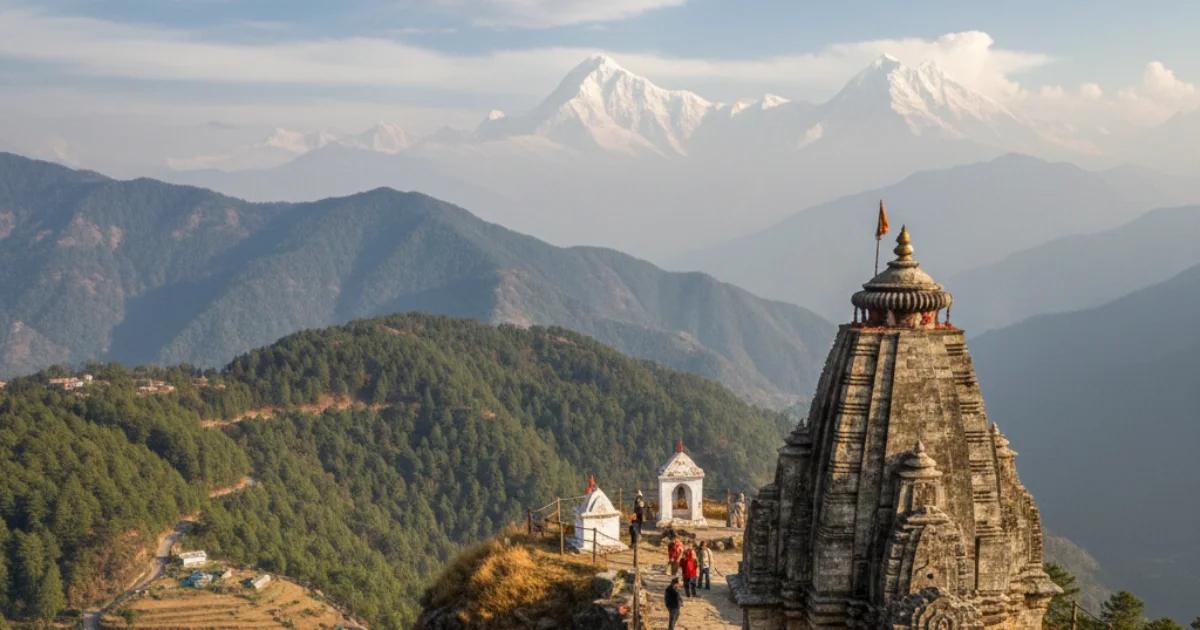
Jageshwar Dham, a cluster of ancient stone temples near Almora. Quieter, older, deeper. Great if you want depth without the crowd.
Purnagiri, a Shakti Peetha near the Nepal border. Crowds here spike hard, especially during Navratri.
Who should pick this circuit over Char Dham? If you're short on time. If high-altitude trekking isn't for you. If you're traveling with kids or elderly parents. Or if what you actually want is mental reset, more than religious ritual.
Who shouldn't skip Char Dham for this? Anyone for whom the traditional Char Dham carries real religious weight. Kainchi Dham complements that journey. It doesn't replace it.
Uttarakhand has been called Devbhoomi the Land of the Gods for centuries. But the pilgrimage itself? That's changed more in the last five years than in the fifty before it. Three things are behind this shift.
First, registration. Since the 2013 floods, the government has run a biometric system for Char Dham. It's gotten stricter every year. You can't just show up anymore. You book a slot. You stick to a cap. In 2026 alone, more than 12.6 lakh pilgrims visited all four Dhams in just the first 25 days. That's not a small number. That's a sign: plan ahead, or don't go.
Second, infrastructure is catching up. Better helicopter services. Stronger checkpoints. There's even a helipad being built near Kainchi Dham right now, just to handle the traffic.
Third, and almost nobody talks about this, the type of traveler is changing. A lot of people searching "pilgrimage" today aren't doing it out of religious duty. They're doing it because they're tired. Tired of noise, tired of screens, tired of vacations that don't actually give them anything back.
Quick takeaway: This isn't the pilgrimage your parents did. Registration is mandatory. Space is limited. And the people making the trip look different than they used to. Plan with that in mind.
|
Myth |
Fact |
|
"You need to be deeply religious to visit these places." |
Most sites, especially Kainchi Dham and Jageshwar — welcome everyone, belief or no belief. |
|
"Char Dham registration includes hotel bookings." |
It doesn't. Registration only covers travel and temple entry. Accommodation is on you. |
|
"Helicopters mean no risk of delay." |
Wrong. Himalayan weather grounds helicopters often, and fast. Always build in a buffer day. |
|
"All four Dhams are equally hard." |
Not close. Badrinath is a drive-up temple. Kedarnath and Yamunotri involve real trekking. This mix-up is the most common planning error people make. |
|
"You can register once you get to the temple." |
No. Checkpoints turn away anyone unregistered before they even get close. Register in advance, always. |
If you are still not sure from where to start then you can use this as your filter. If you really want to experience the thrill and peace and enjoy real trekking then you can do the Char Dham circuit in order that goes as Yamunotri, Gangotri, Kedarnath, Badrinath. You will need 9 to 12 days to travel to these shrines.
If you want something meaningful but falling short on time and physical fitness then you can choose Badrinath plus a Kainchi Dham detour. It gives you a genuine pilgrimage experience in a small time.
If you are travelling with kids and elderly family members with a tight schedule then kainchi dham jageshwar and wider Kumaon circuit provides an indepth spiritual experience.
Traveling with kids or elderly parents, or working with a tight schedule? Kainchi Dham, Jageshwar, and the wider Kumaon circuit give you spiritual depth, without the physical strain.
A Sikh pilgrim, or specifically drawn to Hemkund Sahib? Plan a dedicated June-to-September trip. The trek is demanding enough on its own, don't bolt it onto Char Dham logistics.
Chasing that "reset" feeling, the whole reason you searched this topic in the first place? Go to Kainchi Dham on a Tuesday. Time it for the evening kirtan. It might be the single most concentrated version of that feeling you'll find anywhere in Uttarakhand.
Uttarakhand's pilgrimage sites aren't one thing. They're a spectrum, from tough, high-altitude ritual journeys, to easy, reflective day trips. Treat them as different categories, not one checklist Char Dham and Hemkund Sahib demand registration. Kainchi Dham and most of Kumaon ask for none. Match the place to your body and your time, before you match it to your bucket list. And remember: the "modern" version of pilgrimage in Uttarakhand is real. It's growing. And it doesn't need belief. Just a willingness to slow down.
If you are short on time and want the full traditional experience, and you can handle altitude and trekking? Do the Char Dham circuit, Yamunotri, Gangotri, Kedarnath, Badrinath, between May and June, or September and October. For something quieter, easier, more reflective you can choose Kainchi Dham near Nainital. It is a half-day trip from Delhi's nearest hill stations. You need no registration or physical prep to visit the place. Just go. Honestly, most modern travelers do best by combining both.