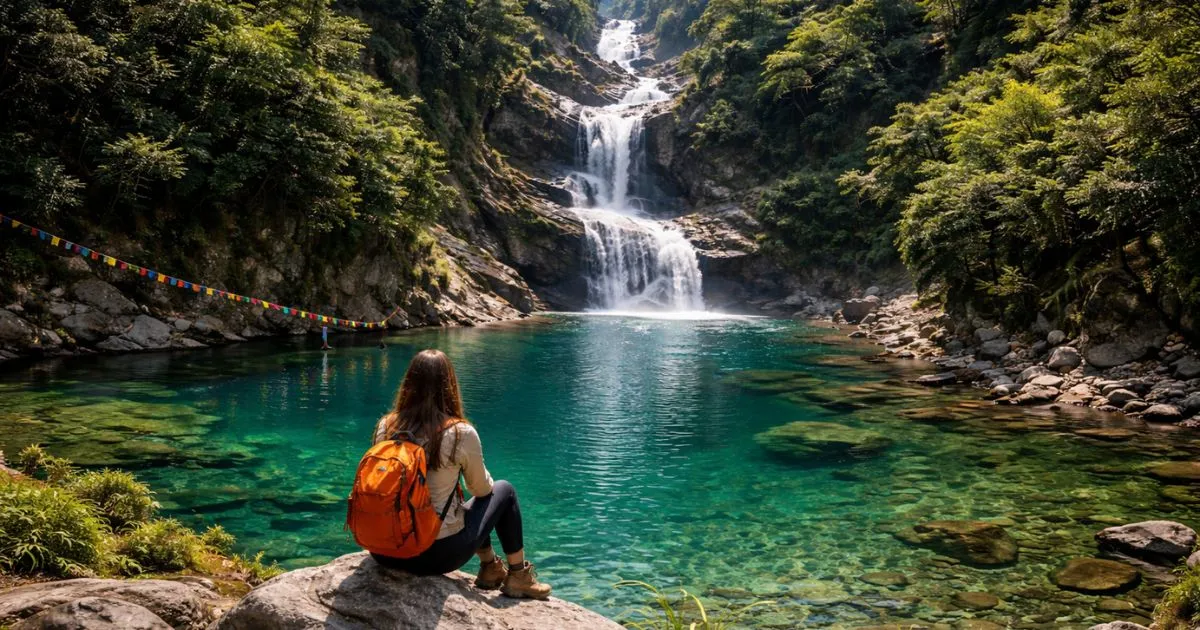
Uttarakhand is jam-packed with waterfalls and lakes in comparison to other states of India. High up in the mountains, above 4,000 meters, you’ll find glacial lakes. They are clear, quiet, and untouched. These natural water sources are not just beautiful to see, but vital to the region’s rivers and life below. Waterfalls drop through dense deodar forests with no crowd in sight or, depending on where you go, every crowd imaginable. Take Kempty Falls near Mussoorie. It draws over a million visitors every year. It’s no surprise Uttarakhand stays high on the travel list, and it is ranked as one of the top five destinations in the country. The state holds both extremes, and most travel content doesn't tell you which is which. Popularity brings attention, but it also changes the experience, and fame doesn’t always mean better.
It often comes down to one simple thing, which is to know where to go. Some places look stunning online with perfect lighting and perfect angles. But when you actually get there, it just doesn’t feel the same. Then some spots don’t try too hard. They may take a little more effort to reach. But once you’re there, it clicks. The view, the vibe, the whole experience, it stays with you. When you know what’s truly worth your time, everything gets easier.
The best waterfalls and lakes in Uttarakhand aren’t always the ones you see all over social media. What really matters is how easy it is to get there and how high up it sits. Pick a place that doesn’t match your fitness level or the season, and things can go sideways fast. So it’s not about chasing the most famous names. It’s about choosing what fits you, at the right time.
In Uttarakhand, waterfalls sit on both ends of the spectrum. Some are right off the road. Easy, quick, no real effort. Others? You’ll need a full day, steady legs, and a bit of patience to reach them. The easy ones give you instant views. The harder ones give you space, silence, and a stronger sense of reward. That’s why a few waterfalls stand out, each for a different reason. Based on this, here are some best waterfalls and lakes to explore in Uttarakhand:
It is the most visited waterfall in Uttarakhand, and that's exactly the issue. It sits about 15 km from Mussoorie on the Yamunotri highway. From a distance, it looks stunning. A wide, 40-metre drop over rugged rock. Hard to ignore. In peak seasons of May and June, it is packed with crowds, you will hear noises everywhere, and chaotic situations. Due to this, the experience drops off quickly. The place is beautiful, but only when you pick the right moment. You can enjoy this place more in November or early March. You will find fewer people, better flow, and a relaxed feel. You will enjoy the place with utmost ecstasy.
Birthi Falls feels like a completely different world. It sits lower, at around 400 metres, tucked inside a thick stretch of pine forest. And unlike crowded spots, this one stays quiet. No chaos. No rush. The drive itself is half the experience. It’s the kind of place where you can just stand still and actually hear the water. You can visit Birthi Falls from July to September to get the best experience of the place. In the monsoon, it has a strong flow, and the surroundings become lush green.
Vasundhra Falls is not a casual stop; it’s a commitment. You start from Mana village. About 5 km one way. No shortcuts. Just a steady uphill push. And the height makes it tougher. Breath gets shorter. Steps slow down. But if you make it, it’s worth it. The waterfall drops from nearly 122 metres. Tall, raw, and untouched. No railings. No concrete. No crowds pushing in. Below, the Saraswati River cuts through a wide, quiet valley. It feels open. Almost empty. In a good way. This only really works if you’re already near Badrinath during the yatra season. That’s roughly May to October, when the routes are open, and conditions are manageable. Vasundhra Falls won't be easy, but it will give you an ultimate experience.
Uttarakhand has over a hundred lakes. Most travelers hear about four or five. Of those, two or three are genuinely worth the planning involved.
The Roopkund Lake in Chamoli district sits at 5,029 metres and is known globally for one reason: the skeletal remains found at its edges, believed by research published in Nature Communications to date across multiple centuries and continents. The mystery is real. The trek is a serious 53 km round trip from Lohajung, typically over 8 days. It demands prior high-altitude experience and goes through Bedni Bugyal, one of the finest alpine meadows in India. Don't attempt it as a first Himalayan trek. Do attempt it if you've done Valley of Flowers or similar.
Deoria Tal proves that you don’t always need a tough climb to get something special. It sits near Ukhimath in the Rudraprayag district. The trek starts from Sari village. Roughly 3 km. Steady, but manageable for most people with decent fitness. On clear mornings, the lake turns into a mirror. The Chaukhamba peaks reflect perfectly on the surface. It’s one of those scenes you’ve probably seen in photos, and yes, it actually looks like that in real life. You can visit this beautiful lake to experience the heavenly beauty of water bodies in the region of Uttarakhand.
Satopanth Tal sits far from the usual travel lists, and that’s exactly why it stands out. It’s remote, high, and deeply quiet. The lake is considered sacred. It lies close to where the Alaknanda River and Saraswati River meet. The setting feels untouched, almost otherworldly. Getting there takes real effort. You’ll cross high-altitude meadows. Loose rocky paths. Glacial moraines. And the weather? It changes fast. Above 4,000 metres, clear skies can flip into a whiteout within hours. What starts calm in the morning can turn rough by afternoon. Visiting Satopanth Lake is raw, beautiful and adventurous. You can visit this water body when you visit Uttrakhand popular waterfalls.
Nainital Lake deserves mention not as a trek destination but as a benchmark of what managed tourism can do wrong at scale. The lake itself, a natural glacial body surrounded by the Kumaon hills, is beautiful. The Mall Road experience around it is not. Water quality in Nainital Lake has been flagged repeatedly by the Uttarakhand Pollution Control Board. It's a good base for exploring nearby Bhimtal or Sattal, which see fewer visitors and have cleaner water. Nainital is the entry point, not the destination.
Timing in Uttarakhand isn't just about weather, it's about what you're trying to experience.
May to June works for high-altitude lakes like Roopkund and Satopanth, when trails reopen after winter. Waterfalls are moderate. Crowds build fast at lower-altitude spots.
July to September is the monsoon season. Waterfalls are at full power. Birthi and Vasudhara look spectacular. But landslides are common on state highways, and high-altitude lake treks become dangerous. This is the season for waterfall seekers, not lake trekkers.
October to November is the clearest window for lakes. Post-monsoon skies are sharp, reflections are clean, and the Himalayan backdrop shows up without haze. Deoria Tal in October is worth the effort ten times over. Most high-altitude routes close by mid-November.
December to March shuts most routes down. Kempty Falls is accessible but minimal. This is not a productive season for the waterfalls and lakes circuit.
The biggest mistake? Treating altitude like a small detail. It isn’t. Roopkund sits at 5,029 metres. Vasundhra Falls climbs close to 4,000 metres. That's a serious height. And altitude doesn’t care how fit you are. You can run marathons and still feel it hit. Acute Mountain Sickness can start showing up as low as 2,500 metres. Ignore it, and it gets worse.
To avoid and deal with this, the Wilderness Medical Society recommends a slow climb. No more than 300–500 metres gain per day once you’re above 2,500 metres. Good itineraries respect that. Most 8-day plans for Roopkund follow it fairly well. But shortcuts? They push too fast. Skip rest days. Cut corners, and that’s where things go wrong.
The second mistake is ignoring permit requirements. The Kedarnath Wildlife Sanctuary, which covers routes to Deoria Tal and parts of Rudraprayag, restricts group sizes. Roopkund treks require registration with the forest department. These aren't bureaucratic formalities; they manage footfall on trails that genuinely can't handle unlimited visitors.
The third is a seasonal mismatch. Visiting Kempty Falls in July for a "waterfall experience" and getting rained out for four days while a landslide blocks the Mussoorie road is not bad luck. It's a planning gap that a hundred online articles could have prevented.